
Let's learn!
EdTech 101.5
ELECTRONIC AMPLIFIERS
1924 - The phonograph, graphophone and other players were purely the mechanical devices through the 1920s. However, in 1924, Columbia began experiments with a new technology developed by the Western Electric Company (the division of AT&T that made telephones and related equipment). Western Electric's recorder used electronic amplifiers to drive an electromagnetic cutting head, rather than relying on the acoustic horn. The result was a louder, clearer record.
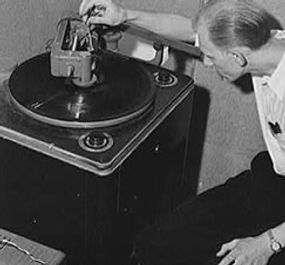
ELECTRICAL ERA
RECORDED SOUND AT THE MOVIES
August 1926 –Warner Bros. and the Vitagraph Studios introduced Vitaphone, the first successful method of mechanically syncing recorded sound to motion pictures. The Vitaphone system was based on a long-playing 16-inch 33 1/3-rpm disc designed for the same playback time as a standard reel of film (maximum of about 11 minutes).

RECORDED RADIO BROADCAST
1928 – Recorded transcriptions for radio programs were introduced as a result of the rise of syndicated programs. Programs could be pre-recorded and pressed onto discs--just as commercial records were --and then distributed to radio stations as syndicated programs. This was an important development for smaller stations that could not afford more expensive live programming. It also gave rise to the DJ, who would play the transcriptions and sometimes introduce in-between program chatter.


LACQUER-COATED BLANK DISC
1934 – Introduction of the lacquer-coated blank disc made instantaneous recording practical for broadcast and home recording use. Major networks soon began systematically recording their programming on 16-inch lacquer-coated aluminum discs that could hold 15 minutes of audio on a side. From 1940 - 45 glass was used for the base material due to aluminum shortages of World War II . Recording to lacquer hung on as late as the 1970s when it was replaced entirely by magnetic tape.
TALKING BOOKS FOR THE BLIND
1934 – The American Federation of the Blind, in collaboration with the Library of Congress and RCA Victor, issued the first Talking Books, long-playing audiobooks on disc for the sight–impaired
DAWN OF MAGNETIC TAPE RECORDER
1935 – The Magnetophon, a pioneering tape recorder, was introduced at the Berlin State Fair. By 1938 tape recording technology improved sufficiently to meet basic broadcasting standards. It wasn’t until after World War II that this technology would begin to render all other methods of capturing sound obsolete.

TAPE RECORDING MINIATURIZED AND QUIETED
1963 – Philips introduced a cassette tape intended to replace open-reel tapes. The advent of cassettes and cassette players provided a medium for the introduction of various Dolby systems of reducing noise and hiss, beginning in 1966.

TRAVELING MUSIC
1980 – Sony introduces the Walkman, a palm-sized stereo cassette tape player, making it easy for listeners to walk about, travel, and exercise while listening through lightweight headphones.

Library of Congress: Recorded Sound Section. (n.d.) A Recorded Sound Timeline. Retrieved from http://www.loc.gov/today/pr/2013/files/recorded_sound_timeline.pdf
Morton, D. (1998). The history of recording technology. Retrieved from http://www.recording-history.org/HTML/musictech1.php